

Introducción a la herramienta Correspondencia
Tabla de contenido
Introducción a la herramienta Correspondencia
La herramienta Correspondencia es tan flexible que puede usarla para gestionar casi cualquier comunicación que desee elevar fuera de su correo electrónico para mantenerla en su sistema formal de registro de Procore.
A continuación, se presentan algunas ideas sobre lo que puede hacer con la herramienta Correspondencia, en función de cómo la utilizan nuestros clientes actuales.
|
|
|
|
|
|




Configuración
Para empezar a utilizar la herramienta Correspondencia en sus proyectos, el administrador de la empresa debe crear primero uno o más tipos de correspondencia de nivel de empresa.
Para aquellos sin permisos de administrador de nivel de empresa: si desea comenzar a utilizar la herramienta Correspondencia, hable con el Administrador de Procore y consulte las listas anteriores para obtener ideas.
Pasos para administradores:
La herramienta Correspondencia es diferente a cualquier otra herramienta de Procore. Mientras que la mayoría de las herramientas de Procore se aplican a un proceso empresarial específico, como las RFI, y vienen con plantillas previas con conjuntos de campos asociados, (por ejemplo, todas las RFI tienen campos de "persona asignada" y "fecha límite"), la herramienta Correspondencia está abierta para que la configure. Al configurar un nuevo tipo de correspondencia para su empresa, básicamente está creando una "herramienta de Procore personalizada" desde cero, lo que incluye decidir qué campos de datos se asociarán con ella. Eso significa que hay un par de pasos de configuración iniciales.
Tenga en cuenta que Procore proporciona las siguientes plantillas prediseñadas para tipos de correspondencia:
- Anexo
- Boletín
- Solicitud de cambio
- Instrucción del cliente
- Restricciones
- Aviso de alerta temprana
- Extensión de tiempo
- Correspondencia general
- Lecciones aprendidas
- Cartas
- Cartas de intención
- Solicitud de material
- Plan de mitigación
- Aviso de retraso
- Aviso para proceder
- Notificación de cargo compensatorio
- Solicitud de permisos
- Solicitud de proyecto
- Identificación de riesgos
- Instrucción de la obra
Puede encontrar las plantillas prediseñadas en la herramienta de Administrador de nivel de empresa. Consulte Añadir una plantilla de tipo de correspondencia. Estas plantillas son una manera fácil de empezar a utilizar la herramienta Correspondencia. A continuación, cuando esté listo para personalizar sus propios tipos de correspondencia, siga los pasos a continuación.
A continuación, se describen los pasos recomendados para configurar nuevos tipos de correspondencia para sus equipos. Puede crear múltiples tipos de correspondencia para su empresa. Para ello, siga las siguientes instrucciones que le guiarán en la configuración de un tipo de correspondencia.
Crear un tipo de correspondencia
Temas a considerar
- El nombre que le asigne al tipo de correspondencia debe describir claramente su uso previsto (algunos ejemplos se muestran en las listas anteriores). El tipo es lo primero que verán los equipos del proyecto cuando inicien una nueva correspondencia dentro de un proyecto, por lo que debe elegir un nombre para ese tipo que reconozcan y comprendan.
- Recomendación: Defina un prefijo dentro del nombre del tipo de correspondencia que los equipos del proyecto puedan entender y reconocer fácilmente. Esto ayudará a que los equipos del proyecto reconozcan rápidamente el tipo de correspondencia cuando lo utilicen en la anotación de plano o lo vinculen a otras herramientas.
- Los permisos se aplican a nivel de tipo y se basan en plantillas (por lo general, por función, dentro de la herramienta Permisos a nivel de empresa). Por lo tanto, considere quién tendrá que ver y usar este tipo de correspondencia y cree tipos separados para acomodar las comunicaciones con audiencias separadas (por ejemplo, un aviso general a un subcontratista sería un tipo separado que un aviso general a un propietario). Consulte Correspondencia: Permisos para obtener más información.
- Recomendación: Seleccione "Privado de forma predeterminada" cuando cree el tipo de correspondencia. Debido a que los permisos de correspondencia se basan en roles, este paso garantizará que solo las partes específicas (p. ej., un subcontratista en particular) puedan ver la correspondencia asignada o distribuida a ellos (en lugar de todos los subcontratistas). (Por el contrario, si la intención del tipo de correspondencia es transmitir información a todos los miembros de un rol de proyecto en particular [p. ej., los subcontratistas], entonces deberá anular la selección de la opción "Privado de forma predeterminada").
- El tipo de correspondencia también aparece en su propia línea en el gráfico "Resumen del proyecto", en la portada del proyecto. De esta forma, puede realizar un seguimiento de los estados de los elementos dentro de cada tipo de correspondencia.
- Si su empresa utiliza una herramienta personalizada (creada por el equipo de Soluciones personalizadas de Procore), no puede tener tipos de correspondencia que coincidan con los nombres de las herramientas personalizadas. Si desea utilizar un tipo de correspondencia que ya esté asociado a una herramienta personalizada, le recomendamos que cambie el nombre de la herramienta personalizada.
Pasos
Crear y aplicar un conjunto de campos
Temas a considerar
- En este paso, está decidiendo qué información (o campos de datos) se asociarán a este tipo de correspondencia. Los campos que añada dictarán qué información recopilarán los equipos del proyecto "ahí fuera" cuando utilicen este tipo de correspondencia en un proyecto real. Por ejemplo, ¿este tipo de correspondencia necesita una fecha límite, un campo de adjuntos o un lugar para documentar el impacto en los costes?
- Puede marcar campos como "obligatorios", "opcionales" u ocultarlos por completo.
- Puede añadir campos personalizados para personalizar aún más el conjunto de campos configurables.
- Puede crear varios conjuntos de campos diferentes para un tipo de correspondencia determinado, a fin de adaptarse a las variaciones en las necesidades de datos para diferentes tipos de proyectos.
Pasos
Después de haber creado la clase de correspondencia, puede terminar de crear el conjunto de campos para la clase de correspondencia.
Actualizar la configuración del conjunto de campos
Comience en el paso 6 de abajo:
- Vaya a la herramienta Administrador de nivel de empresa.
- En "Configuración de herramientas", haga clic en la herramienta para la que desee crear conjuntos de campos configurables.
- Haga clic en la pestaña Conjuntos de campos.
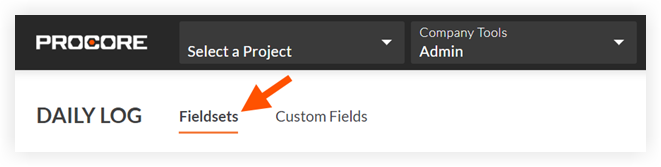
Nota: Las herramientas sin otros ajustes en la herramienta Administrador de nivel de empresa se abrirán en esta página automáticamente. - Haga clic en Crear nuevo en la sección para la que desea configurar conjuntos de campos.
- En la ventana "Crear conjunto de campos", introduzca un nombre para el conjunto de campos y haga clic en Crear.
- En la página "Editar conjunto de campos", cada nombre de campo tiene las opciones siguientes:
- Haga clic en el conmutador de alternancia para ACTIVAR
 la visualización del campo en la sección.
O BIEN
Haga clic en el conmutador de alternancia para DESACTIVAR la visualización del campo en la sección.
Nota: Un icono indica que el campo está visible de forma predeterminada y no se puede ocultar.
 - Marque la casilla de verificación "Obligatorio" para designar el campo como obligatorio.
O BIEN
Desmárquela para designar el campo como opcional.
Notas:- Los campos sin casilla son opcionales por defecto y no pueden cambiarse a obligatorios.
- Una casilla de verificación marcada en gris
 indica que el campo es obligatorio de forma predeterminada y no se puede cambiar a opcional.
- Haga clic en el conmutador de alternancia para ACTIVAR
- Haga clic en Guardar.
- En la ventana "¿Aplicar cambios a [#] proyecto(s)?", haga clic en Asignar proyectos para añadir el conjunto de campos a los proyectos.
- En la ventana "Asignar proyectos", marque la casilla de verificación junto a cada proyecto al que desee aplicar el conjunto de campos y haga clic en Actualizar.
- En la ventana "¿Aplicar cambios a [#] proyecto(s)?", haga clic en Confirmar.
- Opcional: Para establecer un conjunto de campos configurables como predeterminado para nuevos proyectos, haga clic en el icono
 al final de su fila en la pestaña "Conjuntos de campos" y seleccione Establecer como predeterminado para nuevos proyectos.
Nota
Los proyectos creados a partir de una plantilla de proyecto que incluye conjuntos de campos heredarán los conjuntos de campos de la plantilla de proyecto en lugar de los conjuntos de campos predeterminados de su empresa. Consulte Configurar una plantilla de proyecto.
Opcional: Añadir un campo personalizado al conjunto de campos
Comience en el paso 3 de abajo:
- Haga clic en la pestaña Conjuntos de campos.
- Haga clic en Editar junto al conjunto de campos al que desea añadir los campos personalizados.
O BIEN
Haga clic en Crear nuevo para crear un nuevo conjunto de campos. Consulte Crear nuevos conjuntos de campos configurables. - Opcional: Añada el campo a una sección personalizada. Consulte Crear secciones personalizadas y ¿Qué son las secciones personalizadas y qué herramientas de Procore las admiten?
- Desplácese hacia la parte inferior de la página y haga clic en Añadir campo personalizado.
- Haga clic en Crear nuevo.
- Complete la siguiente información para el nuevo campo:
- Nombre de campo: Introduzca un nombre para el campo.
- Tipo de campo. Seleccione el tipo de campo que desea crear.
Nota: Es posible que algunos tipos de campo no estén disponibles para todas las herramientas.Expandir o contraer opciones de tipo de campo
- Casilla. El campo será una casilla que se puede marcar o desmarcar.
- Empresa: El campo será un menú desplegable que permitirá a los usuarios seleccionar una empresa del directorio del proyecto.
- Fecha: El campo permitirá al usuario seleccionar una fecha del calendario.
- Carga de archivos: El campo permitirá añadir archivos adjuntos desde las herramientas compatibles de Procore o desde el ordenador del usuario.
- Ubicación. El campo será un menú desplegable que permitirá seleccionar una ubicación existente.
- Selección múltiple: El campo será un menú desplegable que permite a los usuarios seleccionar varios valores.
- Número. El campo permitirá introducir un valor numérico.
Nota: Cuando un usuario introduce un número en un campo personalizado 'Número' sin valor decimal o con dos ceros después de un punto decimal, las exportaciones de PDF con el campo mostrarán un valor decimal de .0 para el número. Por ejemplo, si un usuario ingresa 123 o 123.00, la exportación de PDF mostrará el número como 123.0. - Texto normal (corto): El campo será un campo de texto libre.
- Usuario del directorio del proyecto (selección múltiple): El campo será un menú desplegable que permitirá a los usuarios seleccionar uno o más usuarios del directorio del proyecto.
- Usuario del directorio del proyecto (selección única): El campo será un menú desplegable que permitirá seleccionar un usuario del directorio del proyecto.
- Entrada de solo lectura: El campo le permitirá escribir un mensaje (como instrucciones) en el cuadro de texto, que será visible en un elemento.
- Texto enriquecido (largo): El campo será un campo de texto enriquecido que admite párrafos para permitir respuestas más largas y texto en negrita, cursiva y subrayado.
- Selección única (lista desplegable): El campo será un menú desplegable que permitirá a los usuarios seleccionar un valor.
- Usuario de herramienta (selección única): El campo será un menú desplegable que permitirá seleccionar un usuario con permisos de "Solo lectura" o superiores para la herramienta.
- Fecha / hora. El campo será una combinación de un menú de calendario y una entrada de hora del día.
- Para los tipos de campo Selección múltiple y Selección única, complete los siguientes pasos para añadir opciones:
- Haga clic en Añadir opciones.
- Introduzca la opción en este campo.
- Para cada opción adicional necesaria, haga clic en Añadir opción e introduzca la opción.
- Haga clic en Guardar opciones.
- Haga clic en Hecho.
- Haga clic en Crear y el campo se añadirá automáticamente en la parte inferior del conjunto de campos.
- Haga clic en el interruptor para cambiar a la para hacer visible el campo personalizado en la sección, o haga clic en la para ocultar el campo personalizado.
- Si el campo personalizado es obligatorio, marque la casilla "Obligatorio". De lo contrario, el campo será opcional.
- Haga clic en Guardar.
- Si el conjunto de campos ya está aplicado a uno o más proyectos, haga clic en Aplicar a existentes.
O BIEN
Si acaba de crear un nuevo conjunto de campos, haga clic en Asignar proyectos y comience en el paso 3 de la sección Aplicar un conjunto de campos con campos personalizados a proyectos que encontrará a continuación. - Opcional: Haga clic y arrastre en el icono de control de ajuste
 para reorganizar el orden en que aparecerán los campos personalizados en un conjunto de campos.
Nota: Los campos estándar de Procore no se pueden reordenar.
Opcional: Añadir una sección personalizada al conjunto de campos para organizar los campos personalizados
Comience en el paso 5 de abajo:
- Vaya a la herramienta Administrador de nivel de empresa.
- En "Configuración de herramientas", haga clic en la herramienta para la que desee crear un campo personalizado.
- Haga clic en Conjuntos de campos.
- Haga clic en Editar junto al conjunto de campos al que desea añadir la sección personalizada.
O BIEN
Haga clic en Crear nuevo para crear un nuevo conjunto de campos. Consulte Crear nuevos conjuntos de campos configurables. - Haga clic en +Añadir sección.
- En la ventana "Añadir sección", introduzca un nombre para la sección y haga clic en Añadir.
- Para añadir uno o más campos personalizados a la nueva sección personalizada, haga clic en Añadir campo personalizado debajo del nombre de la sección personalizada.
- Haga clic en Elija entre las opciones existentes para añadir un campo personalizado existente.
O BIEN
Haga clic en Crear nuevo para crear y añadir un nuevo campo personalizado. Consulte Crear campos personalizados dentro de un conjunto de campos. - Repita los pasos 5 a 8 para añadir más secciones personalizadas.
- Opcional: Para reorganizar las secciones personalizadas, siga estos pasos:
- Pase el cursor junto a la sección personalizada hasta que aparezca el icono de control de ajuste .
- Haga clic en el icono de control de ajuste y arrastre la sección personalizada arriba o debajo de otra sección personalizada.
- Pase el cursor junto a la sección personalizada hasta que aparezca el icono de control de ajuste
- Opcional: Para mover un campo personalizado a una sección personalizada diferente, siga estos pasos:
- Coloque el cursor junto al campo personalizado hasta que aparezca el icono de control de ajuste .
- Haga clic en el icono de control de ajuste y arrastre el campo personalizado sobre el botón Añadir campo personalizado en la sección personalizada a la que desea moverlo.
- Coloque el cursor junto al campo personalizado hasta que aparezca el icono de control de ajuste
- Haga clic en Guardar.
Termine de crear su conjunto de campos y aplíquelo a proyectos
-
Una vez que haya añadido uno o más campos personalizados al conjunto de campos, haga clic en Guardar.
- En la ventana "¿Aplicar cambios a [#] proyecto(s)?":
Importante
La herramienta de correspondencia no se mostrará en un proyecto hasta que se haya creado al menos un tipo de correspondencia y se haya aplicado al proyecto un conjunto de campos para al menos un tipo de correspondencia.- Haga clic en Aplicar a existentes para guardar los cambios en el conjunto de campos en proyectos a los que ya se ha aplicado el conjunto de campos.
O BIEN - Haga clic en Asignar proyectos para añadir o eliminar el conjunto de campos de los proyectos.
- En la ventana "Asignar proyectos", marque la casilla de verificación junto a cada proyecto al que desee aplicar el conjunto de campos y haga clic en Actualizar.
- En la ventana "¿Aplicar cambios a [#] proyecto(s)?", haga clic en Confirmar.
- Haga clic en Aplicar a existentes para guardar los cambios en el conjunto de campos en proyectos a los que ya se ha aplicado el conjunto de campos.
- Opcional: Para establecer un conjunto de campos de forma predeterminada para nuevos proyectos, haga clic en el icono al final de su fila en la pestaña "Conjuntos de campos" y seleccione Establecer como predeterminado para nuevos proyectos.
Ajustar permisos
Temas a considerar
- La configuración de permisos para la correspondencia se basa en plantillas (por lo general, según el rol) y se gestiona en la herramienta Permisos de nivel de empresa.
- Cada tipo de correspondencia tiene su propio juego de permisos, al igual que cualquier otra herramienta de Procore. La configuración de permisos incluye "Ninguno", "Solo lectura", "Estándar", "Administrador" y permisos pormenorizados.
Pasos
- Vaya a la herramienta Permisos de la empresa.
- Haga clic en la pestaña Plantillas de permisos de proyecto.
- Haga clic en Acciones junto a la plantilla para la que desea otorgar permisos pormenorizados y seleccione Editar plantilla.
- Desplácese hasta la sección "Tipos de correspondencia y herramientas personalizadas".
- Seleccione el botón en la columna Ninguno, Solo lectura, Estándar o Administrador en la fila para cada tipo de correspondencia.
- Haga clic en el icono en forma de paréntesis angular > para abrir o cerrar el menú de permisos pormenorizados de cada tipo de correspondencia.
Nota: Este icono solo se muestra cuando se selecciona Solo lectura o Estándar. - Marque la casilla de verificación "Activar TODO" para habilitar todos los permisos pormenorizados de la herramienta Correspondencias en la plantilla de permisos.
Nota: El nombre de esta casilla de verificación cambia a "Desactivar TODO" si todos los permisos pormenorizados de la herramienta Correspondencia están habilitados.
O BIEN
Marque la casilla de verificación correspondiente a cada permiso pormenorizado que desee habilitar en la plantilla de permisos.
- Haga clic en Guardar.
Ajustes de configuración avanzados en un proyecto
Hay ajustes adicionales que puede configurar para cada tipo de correspondencia en el nivel del proyecto. Puede utilizar esta configuración para:
- Habilitar recordatorios por correo electrónico para elementos atrasados
- Definir una lista de distribución predeterminada
- Establecer fechas límite de respuesta automáticas
- Añadir una descripción predeterminada
Pasos
Configuración de pestaña
- Vaya a la herramienta Correspondencias del proyecto.
- Haga clic en el icono Ajustes de configuración
 y seleccione el tipo de correspondencia para el que desea configurar los ajustes.
 - Haga clic en Configuración de pestaña en la barra lateral.
- Cumplimente lo siguiente según sea necesario para el proyecto:
Nota: Los usuarios que crean o editan un elemento de correspondencia utilizando este tipo de correspondencia pueden cambiar los campos Distribución, Fecha límite y Descripción de elementos individuales.- Distribución predeterminada: seleccione uno o más usuarios o grupos de distribución en el menú desplegable. Haga clic en el icono
 junto al nombre de un usuario si desea eliminarlo de esta lista.
Nota: Los usuarios deben tener permisos de nivel de solo lectura o superiores en el tipo de correspondencia para que se les pueda añadir a esta lista. Consulte Conceder permisos pormenorizados en una plantilla de permisos de proyecto. - Las respuestas vencerán: introduzca el número de días laborables predeterminados después de los cuales una respuesta vencerá.
- Descripción predeterminada: introduzca una descripción predeterminada para añadirla a los elementos creados con este tipo de correspondencia.
- Ajustes de correo electrónico: marque o desmarque las casillas de verificación debajo de cada rol de usuario para determinar quién recibirá las notificaciones por correo electrónico de cada evento de correo electrónico. Consulte ¿Quién recibe correos electrónicos de artículos de correspondencia y notificaciones push? para obtener más información.
Nota: Algunos ajustes de correo electrónico están configurados a nivel de empresa y afectan a todos los proyectos. Por ejemplo, la casilla de verificación "Enviar recordatorios por correo electrónico para elementos atrasados" se describe en Crear un nuevo tipo de correspondencia.Importante
Si se utiliza un flujo de trabajo de autoservicio de correspondencia personalizado en un proyecto, las notificaciones por correo electrónico de elementos de correspondencia para ese proyecto se administran a través de los ajustes de configuración del flujo de trabajo. Consulte (Beta) ¿Cuándo se envían las notificaciones por correo electrónico para los flujos de trabajo personalizados de autoservicio? para obtener más información
- Distribución predeterminada: seleccione uno o más usuarios o grupos de distribución en el menú desplegable. Haga clic en el icono
- Haga clic en Actualizar para guardar los cambios.
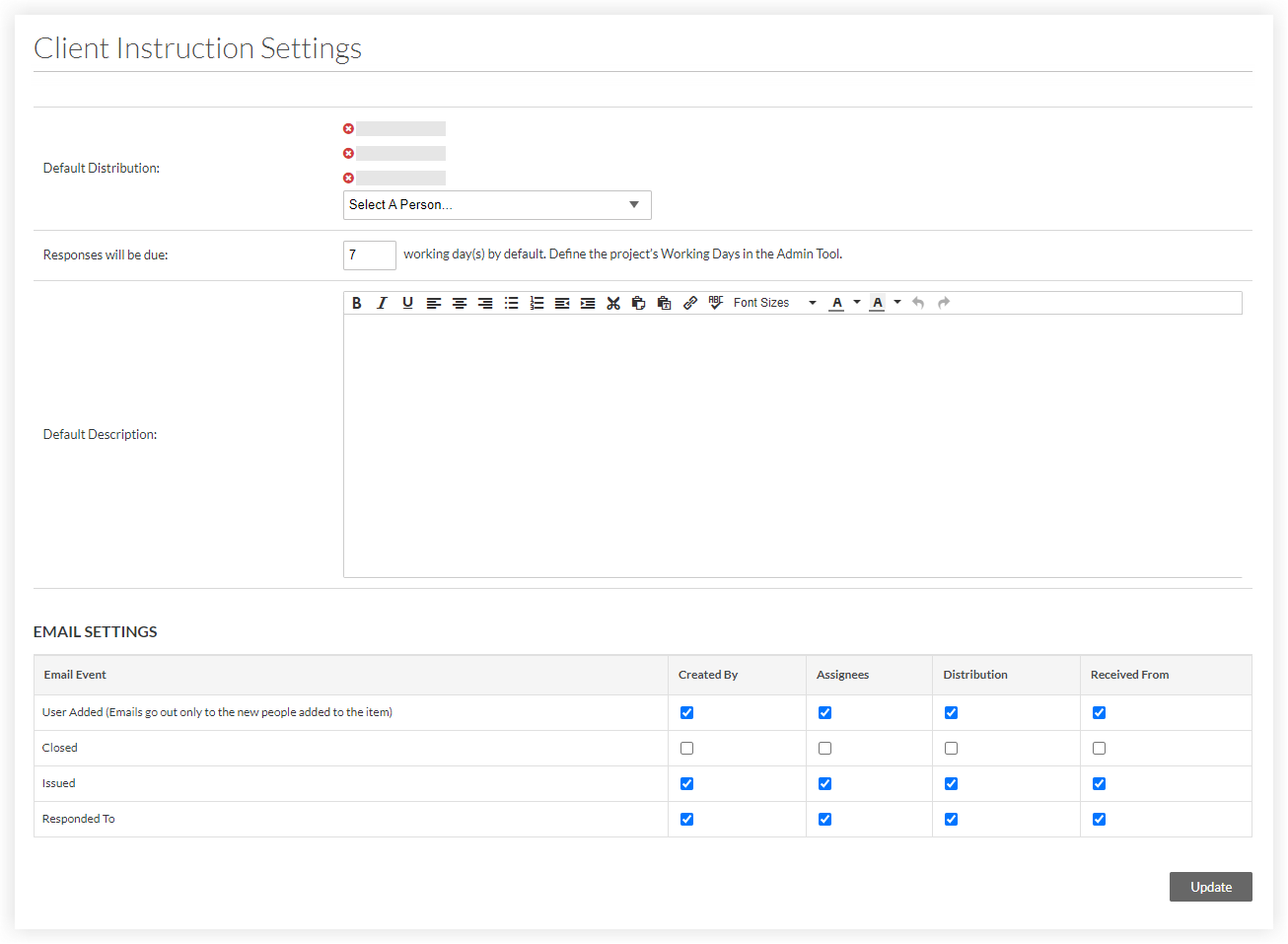
Tabla de permisos
- Vaya a la herramienta Correspondencias del proyecto.
- Haga clic en el icono Ajustes de configuración y seleccione el tipo de correspondencia cuyos permisos de usuario desea ver.
- Haga clic en la Tabla de permisos en la barra lateral.
Se mostrará la tabla Permisos de usuario para el tipo de correspondencia.- El icono de marca de verificación verde
 indica el nivel de permiso que se le ha otorgado al usuario en el tipo de correspondencia: "Ninguno", "Solo lectura", "Estándar" o "Administrador".
 - El icono rojo
 indica qué niveles de permisos no están asignados al usuario.
 - El icono gris
 indica qué niveles de permisos no están asignados al usuario y no se pueden cambiar actualmente, puesto que al usuario se le ha asignado una plantilla de permisos de proyecto. Para cambiar sus permisos en la herramienta Directorio de nivel de proyecto, consulte Cambiar los permisos de un usuario en el Directorio del proyecto.
Sugerencia
Consulte Matriz de permisos de usuario: web y Matriz de permisos de usuario: móvil para obtener más información sobre las diferentes acciones que pueden realizar los usuarios con el nivel de permiso que seleccione.
- El icono de marca de verificación verde
- Para cambiar el nivel de permisos de un usuario en el tipo de correspondencia cuando no tiene una plantilla de permisos del proyecto asignada, haga clic en el icono rojo correspondiente al nivel de permiso que desea otorgar al usuario.
El icono rojo se sustituirá por una marca de verificación verde El icono y el nivel de permisos del usuario para el tipo de correspondencia se guardarán automáticamente.
Prácticas recomendadas
Planificación
Debido a que la herramienta Correspondencia es tan flexible, es importante tener un plan integral por adelantado para asegurarse de que lo está utilizando de una manera eficiente que se adapte a las necesidades de sus equipos.
Temas a considerar
- Encuesta a las partes interesadas internas. Puede crear múltiples tipos de correspondencia diferentes; asegúrese de haber recibido la opinión de los equipos sobre cuáles son los más críticos o beneficiosos para sus proyectos.
- Identifique los procesos que encajan bien. Para un proceso determinado, si responde "sí" a las preguntas siguientes, es probable que la correspondencia sea una buena opción.
- ¿Este proceso se basa en compartir información y comunicarse con otras partes Interesadas? ¿Necesita que las partes Interesadas sean responsables de recibir o responder a esta información?
- ¿Este proceso se está manejando actualmente por correo electrónico o incluso por teléfono/mensaje de texto?
- ¿Beneficiaría a su empresa formalizar y centralizar la comunicación en torno a este proceso?
- ¿Existe el riesgo de perder tiempo o dinero si este proceso no se sigue o registra correctamente?
- ¿Tiene plantillas existentes que utiliza para este proceso?
- ¿Actualmente está completando este proceso fuera de Procore o dentro de una de las herramientas personalizadas de Procore?
- ¿Es necesario vincular este proceso a las RFI y los eventos de cambio para un seguimiento completo?
- ¿Se beneficiaría este proceso de estar vinculado a una anotación de plano?
- Evalúe el panorama general. Diseñe su plan para los tipos de correspondencia y sus datos asociados, para asegurarse de que esté utilizando la correspondencia de manera eficiente, sin redundancia y de una manera que tenga sentido para sus equipos y procesos.
Despliegue
El despliegue y la adopción correctos requieren que los equipos se unan y comiencen a utilizar la nueva funcionalidad. Eso significa que las personas deben conocer la funcionalidad, sus expectativas de uso y dónde acudir para obtener ayuda y comentarios.
Temas a considerar
- Socialización. Asegúrese de que los equipos del proyecto conozcan los tipos de correspondencia que haya configurado y aclare las expectativas para el uso de la correspondencia. Haga anuncios amplios y brinde oportunidades para preguntas y respuestas (idealmente, más de una vez). Actualice los manuales de procedimientos de la empresa en consecuencia.
- Tren. Si los equipos necesitan formación sobre Correspondencias, remítalos al sitio de soporte técnico de Procore o al icono de ayuda de la aplicación, a la página de seminarios web o póngase en contacto con su punto de contacto de Procore para solicitar formación personalizada.
- Recopile comentarios. Mantenga una línea de comunicación abierta con los equipos del proyecto para que pueda obtener información directa sobre lo que está funcionando bien o dónde posiblemente deba realizar ajustes.
- Utilice informes y paneles. Supervise los números y los estados de la correspondencia en todos los proyectos, de modo que pueda identificar áreas para mejorar la adopción, aclarar expectativas o realizar cambios en sus plantillas.